If you liked The Catcher in the Rye ...
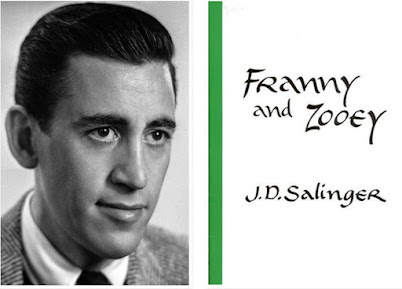
Read Franny and Zooey.
Catcher is about a lot of things, but one is phoniness. Holden thinks everything and everyone is phony. Gladhanding headmasters, pseudo-intellectuals, preachers with “holy Joe” voices – all phonies. No question, Holden’s hypercritical mindset is part of a complex interwoven set of defense mechanisms designed to keep him from acknowledging his own emotional pain, but even with the unreliable nature of his narration, I have always thought that most of the things he labels phony really are phony.
Phoniness, for Holden, involves inauthenticity. Fakeness. When he talks about institutions being phony, he is calling out the wide distance between how an institution projects itself and how it really is – usually done through PR, advertising, and other carefully crafted outward displays. Holden, for instance, says that his school, Pencey Prep, "advertise[s] in about a thousand magazines, always showing some hotshot guy on a horse jumping over a fence. Like as if all you ever did at Pencey was play polo all the time. I never even once saw a horse anywhere near the place." What drives Holden crazy is what we now call branding.
More often, though, Holden labels people as phony, and while we understand why an institution would want to project a certain image, it’s more complicated when it comes to people. During the couple of days we tag along with Holden, he meets (or recalls) a wide variety of people who, in his estimation, are engaging in behavior that we would now call “performative.” Like the Pency Prep guidebook, these people are self-consciously manipulating “carefully crafted outward displays” for the world to see. (Sidenote: imagine what Holden and his antennae for phoniness would think of social media.)
In one of my favorite under-the-radar Holden-identifies-a-phony moments, he is standing in the lobby of a theater with Sally Hayes during the intermission between acts. Suddenly, Sally recognizes a guy she knows, and eventually this person comes over and joins them. Holden’s description of this “Strictly Ivy League" guy is comical: “You should have seen him when old Sally asked him how he liked the play,” he tells us. “He was the kind of phony that have to give themselves room when they answer somebody's question. He stepped back, and stepped right on the lady's foot behind him...I was all set to puke when it was time to go sit down again.”
Holden never quite gets at the reason why all of these phonies feel compelled to project themselves in one way or another (what we might now call personal branding). With an institution or a business, it is easy enough to do the math: the school wants to have more applicants, the business wants to sell more widgets. Holden points out the phoniness but never investigates the reasons behind it.
While Holden might not have enough emotional intelligence to see the drivers behind phoniness, it becomes apparent to the reader.
It’s all about ego.
That brings us to Franny and Zooey.
The book is comprised of a short story, “Franny,” followed by a novella, “Zooey.” In the opening story, Franny is having a breakdown. She is so closely attuned to the way that others around her posture and act and perform, all seemingly motivated by ego, that she becomes almost paralyzed, unable to do anything except mumble her prayers (which she chants like a Zen koan), the only thing she seems able to do that is not driven by ego. The story is about a “date” she is on with a dude named Lane, who is a little bit like the guy in the theater lobby described above. In their brief date, we see Franny trying to “play the game” (this is Spencer’s advice to Holden in Catcher), but she is in an existential free fall as she recognizes that seemingly every human social action is motivated by ego. She does not exclude herself from this tendency: she has quit acting because she realizes, painfully, that every performance was driven by the need for applause. I’ll let you read about what happens, but it is a fascinating study of the trouble that can come when someone puts on powerful X-Ray glasses and can’t take them off. Seeing through the surface bullshit of the world is certainly a good thing, but when does it become a burden? When does it become debilitating? When does it make it hard to live? In many ways, Franny’s burden is no different than Holden’s, but Holden isn’t mature and/or self-aware enough to realize what is happening. Franny is – and that makes for a very intriguing story.
In the novella that follows, Franny's brothers try to help her through this existential crisis (in the same way that Mr. Antolini tries to help Holden understand what is happening). There are long conversations, long letters, long accountings of Glass family history (all the children were prodigies of one sort or another), and a healthy dose of Zen Buddhism. Despite a somewhat meandering text, Salinger's intellectual focus stays squarely on the relationship between ego and what Holden calls "phoniness."
Personally, this has always been a fascinating question for me. Once you put those X-Ray glasses on, once you recognize ego-driven performative behavior, how do you live in the world? In the middle of Catcher, Holden explains why he doesn't like seeing live theater: "The trouble with me is, I always have to read that stuff by myself. If an actor acts it out, I hardly listen. I keep worrying about whether he's going to do something phony every minute." And that’s the problem. As soon as you see the phoniness of the world you can’t not see it.
If you look closely at Catcher, you will find some pretty good advice on how to navigate a world overflowing with phoniness. Mr. Antolini, Holden’s sympathetic former English teacher, gives a thoughtful speech at the end about this exact topic. Even though he is “oiled up” on highballs, and Holden is too tired and sick to hear much of anything that he says, and the entire speech is undercut by the “patting or petting” incident at the end, Antolini delivers a message to Holden that is inspiring and powerful. You are not the only one “sickened” by human behavior, he tells him. You are not the only one to see the phoniness of people and institutions; you are not the only one who ever questioned the system and asked whether or not you wanted to be a part of it. Antolini sends Holden back to literature, art, poetry, and writing to find voices that ring true, and in many ways this is exactly what I have always tried to do as a teacher.
The most interesting thing about Franny and Zooey is that unlike Holden, Franny listens. Her brothers, particularly Zooey and Buddy, are trying to help her reach the other side of an existential crisis that they both went through earlier in their lives. I won’t tell you exactly how it ends, but Salinger’s answer to the problem of how to live in a phony world involves a complicated mix of familial love, Zen Buddhism, and faith-based optimism.
It is hard to imagine being on the edge of your seat while reading a book where very little happens, but that’s how it was for me when I first read F&Z. Having worked for thirty-plus years at an institution obsessed with public relations, branding, and message control, I was desperate for some practical advice on how to keep from drowning in phoniness. In Franny and Zooey, Salinger gives us his best shot.
Comments
Post a Comment